
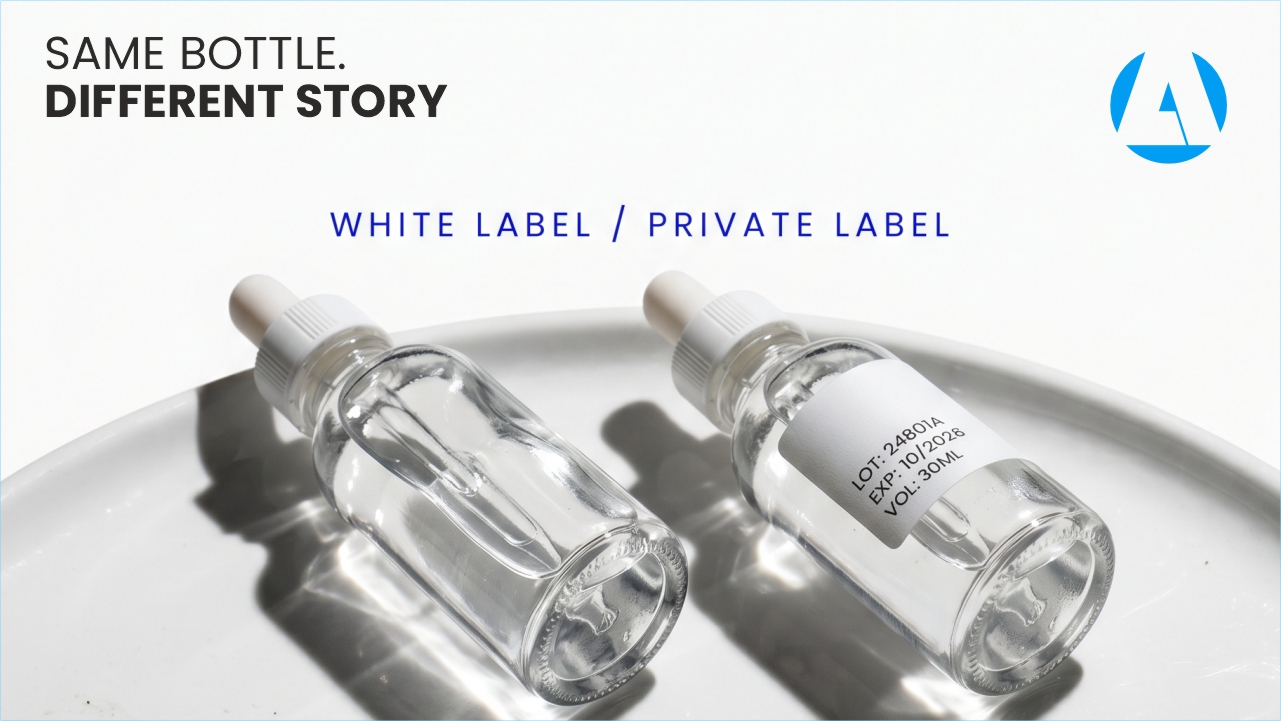
What Is a White Label Product? And How Is It Different from Private Label Manufacturing?
You have a brand idea. You know your target customer. You even have a name and a logo ready. But when it comes to actually making the product, two terms keep coming up: white label and private label.
Most people use them interchangeably. They are not the same.
Understanding the difference between these two manufacturing models can save you time, money, and a lot of confusion — especially when you are just starting out or planning to scale.
Let's break it down clearly.
Why This Confusion Exists
The beauty and personal care industry has grown fast. New brands launch every week. And most of them — wisely — do not build their own manufacturing facilities.
Instead, they partner with manufacturers who can produce products on their behalf.
This is where white label and private label manufacturing both come in. Both allow you to sell a finished product under your own brand name. But the way those products are developed, formulated, and owned is very different.
What Is a White Label Product?
A white label product is a finished, pre-formulated product made by a manufacturer and made available to multiple brands simultaneously.
Think of it like a blank canvas that already has a painting on it. The manufacturer creates a standard product — a face wash, a moisturizer, a serum — and multiple brands can purchase it, put their own label on it, and sell it as their own.
The product formula, texture, fragrance, and ingredients remain the same across all brands buying that product. What changes is only the name, logo, and packaging.
Key Characteristics of White Label Products
- Ready-to-use formulations with no development time
- Available to multiple brands simultaneously
- Low or no minimum order quantities in many cases
- Faster time to market
- Lower upfront investment
- Limited or no customization of the formula
White label works well for brands that want to launch quickly without investing in product development. It is a practical entry point for new businesses testing the market.
What Is Private Label Manufacturing?
Private label manufacturing is a step further. Here, a brand works with a manufacturer to develop a product that is exclusively theirs.
The formulation may be developed from scratch or customized significantly from a base formula. The brand has input over ingredients, actives, texture, fragrance, pH, packaging, and sometimes even the stability profile.
Once developed, that product belongs exclusively to the brand. No other brand can purchase or sell the same formulation from that manufacturer.
Key Characteristics of Private Label Manufacturing
- Exclusive formulation developed for one brand
- Higher degree of customization
- The brand owns the product identity
- Longer development timeline
- Higher minimum order quantities typically apply
- Greater investment upfront
- Stronger brand differentiation in the market
Private label is the preferred model for brands that want to stand out, build a loyal customer base, and control what goes into their products.
White Label vs. Private Label: Side-by-Side Comparison
|
Feature |
White Label |
Private Label |
|---|---|---|
|
Formulation |
Pre-made, standard |
Custom or exclusively developed |
|
Exclusivity |
Shared across brands |
Exclusive to one brand |
|
Customization |
Minimal |
High |
|
Time to Market |
Fast |
Longer |
|
Investment |
Lower |
Higher |
|
MOQ |
Often lower |
Typically higher |
|
Brand Differentiation |
Limited |
Strong |
|
Formula Ownership |
Manufacturer's |
Brand's (in most cases) |
|
Best For |
New brands, quick launch |
Established or differentiated brands |
Which Model Is Right for You?
The honest answer is: it depends on where you are in your brand journey.
Choose White Label If:
- You are launching your first product and want to test the market
- You have a limited budget and need to move fast
- You are not yet ready to invest in custom formulation
- You want to focus on marketing and distribution rather than product development
Choose Private Label If:
- You have a clear brand identity and want a product that reflects it
- You want to use specific ingredients or actives that are not in standard formulations
- You are building a long-term brand and need differentiation
- You are ready to invest in development and work with an R&D team
- You want to own your formula and protect it from being replicated by competitors
Many successful brands actually start with white label, learn the market, generate revenue, and then move to private label as they grow. There is no shame in starting simple.
A Common Misconception Worth Clearing Up
Many new brand owners assume that private label means lower quality than white label, or vice versa. This is not accurate.
Quality depends entirely on the manufacturer — their raw materials, their processes, their quality control systems, and their compliance with regulatory standards like GMP and ISO 22716.
A well-manufactured white label product can outperform a poorly developed private label product, and the reverse is equally true. What matters is who makes it and how.
This is why choosing the right manufacturing partner matters far more than which model you choose.
What About OEM Manufacturing?
You may also come across the term OEM (Original Equipment Manufacturer). In the cosmetics and personal care industry, OEM is often used interchangeably with contract manufacturing or private label.
Technically, OEM refers to a manufacturer that produces goods based on the buyer's specifications. In practice, it broadly covers custom product development and manufacturing for brands — which overlaps significantly with private label.
The terminology varies by region and industry. What matters is understanding what level of customization, exclusivity, and ownership you are getting from your manufacturing partner.
How Acticon Life Sciences Approaches This
At Acticon Life Sciences, we work with brands across both models. Whether you need a ready formulation to launch quickly or a fully customized product developed from the ground up, our team guides you through the right approach based on your goals, timeline, and budget.
Our R&D team, GMP-certified facility, and quality assurance processes remain consistent regardless of the model — because product safety and quality are non-negotiable at every level.
Frequently Asked Questions
Q1. Can I change the ingredients in a white label product?
Generally, no. White label products are pre-formulated and standardized. If you need ingredient changes, you would need to move to a private label or custom formulation model.
Q2. Will other brands have the exact same product as mine if I choose white label?
Yes. The formula will be identical. Differentiation in white label comes primarily from branding, packaging design, and marketing — not the product itself.
Q3. Is private label more expensive than white label?
The upfront investment is usually higher for private label due to formulation development, stability testing, and higher MOQs. However, the long-term return can be greater because of exclusivity and brand differentiation.
Q4. How long does private label product development take?
It varies depending on the complexity of the formulation and testing requirements. Typically, it can range from a few weeks for minor customizations to several months for fully custom formulations.
Q5. Can I switch from white label to private label later?
Absolutely. Many brands start with white label, build their customer base, and then invest in private label as they scale. A good manufacturing partner will support you through both stages.
Q6. Who owns the formula in private label manufacturing?
This depends on the agreement with your manufacturer. In most cases, the brand owns the formula if it was developed exclusively for them. Always clarify formula ownership before signing any agreement.
Q7. Is white label legal? Can I really sell someone else's product as my own?
Yes, it is completely legal and standard industry practice. The manufacturer produces the product; your brand markets and sells it. This model is used across cosmetics, food, pharmaceuticals, and electronics globally.
White label and private label are both legitimate, widely used business models in cosmetic and personal care manufacturing. Neither is inherently better than the other.
White label gives you speed, simplicity, and a lower barrier to entry. Private label gives you exclusivity, customization, and stronger brand identity.
The right choice depends on your brand stage, budget, and long-term goals. What remains constant is the importance of partnering with a manufacturer who maintains high standards regardless of the model you choose.
Looking to launch a skincare, cosmetics, or personal care product — whether through white label or private label manufacturing? Acticon Life Sciences offers end-to-end product development and manufacturing solutions built on quality, compliance, and genuine expertise. Reach out to our team to find the right model for your brand.