
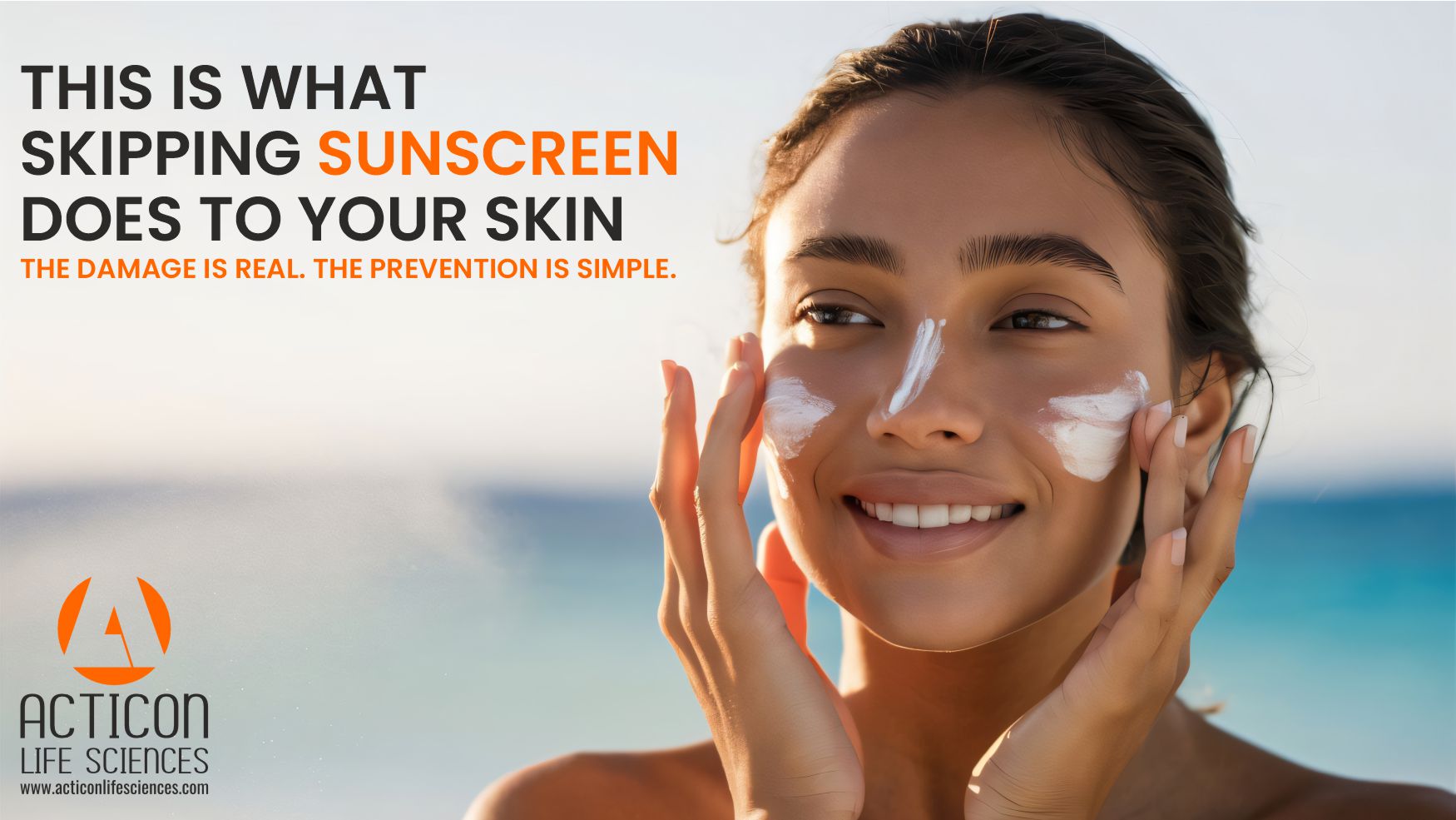
What Happens to Your Skin When You Stop Using Sunscreen? The Truth Most People Ignore
We hear this a lot — from consumers, from brand partners, and honestly, from people we know personally: "I only use sunscreen at the beach."
It's one of the most common skincare mistakes people make. And the frustrating part is that the consequences don't show up overnight. They creep in slowly — a patch of pigmentation here, a fine line that arrived earlier than expected there, a skin tone that just doesn't look as even as it used to. By the time most people connect the dots, years of quiet UV damage have already accumulated.
At Acticon Life Sciences, we work closely with skincare brands to develop sun-protection formulations — and the science behind what unprotected UV exposure actually does to skin is something we think more consumers deserve to understand. So let's get into it.
What Your Skin Is Actually Dealing With Every Day
Before we talk about what happens when you stop using sunscreen, it helps to understand what sunscreen is protecting you from in the first place.
Sunlight contains two types of ultraviolet radiation that affect your skin differently.
UVA rays penetrate deep into the skin's dermis. They don't burn you — at least not visibly — but they silently break down collagen, trigger pigmentation, and accelerate the aging process. They're present year-round, at roughly the same intensity regardless of season or weather. And critically, they pass straight through glass — which means sitting by a window counts as sun exposure.
UVB rays are the ones responsible for sunburn. They're more intense in summer and at higher altitudes, and they do visible, acute damage to the skin's surface. They're also the primary driver of the tanning response most people notice after time outdoors.
Both types accumulate. Every unprotected hour adds to a lifetime total of UV exposure — and that total is what ultimately determines how your skin ages.
The First Thing You'll Notice: Uneven Pigmentation
If you stop using sunscreen, pigmentation is usually one of the earliest changes people notice — though many don't immediately recognize what caused it.
Here's what's happening underneath: UV exposure triggers your skin to produce melanin as a protective response. More sun, more melanin, more pigmentation. This shows up as tanning, yes, but also as dark spots, uneven skin tone, and post-acne marks that become noticeably darker and slower to fade.
This is also why people who invest in brightening serums — vitamin C, niacinamide, alpha arbutin — sometimes feel like those products have stopped working. They haven't. It's that UV exposure is continuously generating new pigmentation faster than the actives can address it. Without SPF as a foundation, brightening ingredients are fighting an uphill battle.
It gets more complicated if you're using exfoliating acids, retinol, or AHAs and BHAs — all of which increase your skin's sensitivity to sunlight. Without sunscreen, these ingredients can actually worsen pigmentation instead of improving it, because they're exposing fresher, more reactive skin cells to UV damage.
Premature Aging — This One Sneaks Up on You
Photoaging is probably the most well-documented consequence of skipping sunscreen, and the numbers behind it are genuinely striking. Research consistently shows that the majority of visible facial aging — fine lines, wrinkles, loss of firmness, rough texture — is attributable to UV exposure rather than chronological age alone.
Think about what that means practically: two people the same age, with similar genetics and skin types, can have dramatically different skin quality in their 40s and 50s based largely on sunscreen habits. That's not a small difference. That's the kind of difference that's visible across a room.
The mechanism is straightforward. UVA rays break down collagen and elastin — the structural proteins responsible for your skin's firmness and bounce. Once collagen degrades, it doesn't come back easily. Fine lines deepen. Skin loses its ability to snap back. That subtle loss of glow and firmness that people often attribute to "just getting older" is, in many cases, actually the cumulative result of unprotected sun exposure over years.
Your Skin Barrier Takes a Hit Too
Your skin barrier — the outermost layer of your skin — does a quiet but essential job. It keeps moisture in, keeps irritants out, and maintains the balance that keeps your skin feeling comfortable and resilient.
Prolonged UV exposure weakens this barrier. The lipids that hold skin cells together get damaged. The barrier becomes more permeable, which means moisture escapes more easily and irritants get through more readily.
The result? Skin that feels drier, more reactive, and more prone to redness and sensitivity — even if you're doing everything else right. A lot of people cycle through moisturizers trying to solve persistent dryness without realizing that unprotected UV exposure is the thing undermining their barrier in the first place.
For Anyone Dealing With Acne: Sunscreen Is Non-Negotiable
If you're managing acne or post-acne marks, skipping sunscreen makes an already frustrating situation worse.
Post-inflammatory hyperpigmentation — the flat dark marks that remain after a breakout heals — is highly sensitive to UV exposure. Without sun protection, those marks darken more quickly, take longer to fade, and often become more difficult to treat with topical ingredients. This is exactly why dermatologists almost always include sunscreen in their acne treatment protocols. It's not a nice-to-have addition. It's protecting the progress everything else is trying to make.
Yes, You Can Get Sun Damage Indoors
This one genuinely surprises people. If you work from home, sit near windows during the day, or drive regularly, your skin is receiving meaningful UVA exposure — even if you never step outside.
UVA rays, unlike UVB rays, penetrate standard window glass without significant filtering. That means the light coming through your office window or car windshield is still affecting your skin. Not as intensely as direct midday sun, but consistently, across years, it adds up.
This is the reason dermatologists and skincare professionals recommend daily SPF — not just on beach days, not just in summer. Every day, as a baseline habit.
What Years Without Sunscreen Actually Look Like
The long-term picture of chronically unprotected skin is one we see reflected in the formulation briefs that come to us from skincare brands. Consumers are increasingly seeking solutions for:
- Persistent dark spots and uneven skin tone
- Deep, established wrinkles that appeared earlier than expected
- Loss of firmness and elasticity
- Roughened skin texture
- Enlarged pores
- Dullness that doesn't respond to brightening products
Many of these concerns are treatable — but not easily, and not quickly. Correcting established photoaging requires consistent use of proven actives, sometimes in-clinic treatments, and time. Prevention through daily sunscreen is dramatically more efficient than correction after the fact.
Good News: Your Skin Can Partially Recover
If you've been inconsistent with sunscreen — or never really used it — starting now still makes a meaningful difference.
Once you begin applying SPF consistently, further damage slows significantly. Skincare actives you're already using become more effective because they're not constantly being undermined. Pigmentation can gradually improve when it's no longer being reinforced by UV exposure. Your skin barrier gets a chance to recover.
What won't fully reverse on its own is significant collagen loss and established photoaging. But halting ongoing damage is still a major win — and it makes every other skincare investment you're making work better.
How the Sunscreen Category Has Changed — And Where We Come In
One of the most common reasons people used to skip sunscreen was texture. White cast on deeper skin tones. Greasiness that made skin look shiny. A heavy feeling that sat on top of the skin all day. For many consumers, especially those with oily or acne-prone skin, the experience was just unpleasant enough to skip.
That's changed significantly — and we at Acticon Life Sciences have been part of that change.
Consumer expectations for SPF formulations are genuinely different now. People want sunscreen that:
- Sits invisibly on the skin, regardless of skin tone
- Works comfortably as a standalone product or under makeup
- Doesn't clog pores or worsen oiliness
- Delivers additional skincare benefits alongside protection
- Feels like something they'd actually want to wear every day
We've worked with skincare brands to develop formulations that meet these expectations — gel sunscreens with matte finishes, lightweight serum-SPF hybrids, tinted mineral formulations designed for a range of Indian skin tones, and SPF moisturizers that function as a genuine last step in a skincare routine rather than an afterthought.
From a manufacturing standpoint, these aren't simple products. They require careful formulation to maintain SPF efficacy while achieving the elegant textures consumers expect. Stability testing, photostability assessment, and rigorous quality control all play a role. These are capabilities our team has built specifically to support brands developing sun-care products for competitive markets.
As sunscreen awareness grows — driven by dermatologists, skincare educators, and a generation of consumers who actually read ingredient labels — the demand for high-performance SPF products is only going to increase. We're helping our brand partners be ready for that.
Starting (or Restarting) Sunscreen: What Actually Matters
If you've been inconsistent with sunscreen, the most important thing is to build the habit — not to find the perfect product immediately.
A few practical principles worth following:
SPF 30 is the floor, not the ceiling. SPF 30 blocks roughly 97% of UVB radiation. SPF 50 gets you to about 98%. For daily use, SPF 30–50 is appropriate for most people; higher if you're spending extended time outdoors.
Apply enough. Most people under-apply sunscreen significantly, which means their actual protection is much lower than the SPF number suggests. For the face, a nickel-sized amount is a common guideline.
Reapply if you're outdoors for extended periods. For typical indoor days, a morning application is generally sufficient. For outdoor activities, reapplication every two hours matters.
Cloudy days still count. UV radiation passes through clouds. The absence of visible sun doesn't mean the absence of UV exposure.
Consistency beats perfection. A sunscreen you'll actually wear every day — even if it's not your dream formula — is far better than a theoretically superior product that sits on your shelf.
FAQs
Do I really need sunscreen every single day?
Yes. UV exposure happens daily, regardless of season, weather, or whether you spend most of your time indoors. UVA rays in particular are present and penetrating year-round.
What happens if I stop using sunscreen for a month?
It depends on your level of sun exposure, but most people will notice some increase in tanning, dullness, or uneven pigmentation. Existing dark spots may darken. The effects accumulate, so the longer the gap, the more noticeable the changes.
Can sunscreen genuinely prevent aging?
It can prevent a significant portion of it. Since UV exposure is responsible for the majority of visible facial aging, consistent sunscreen use is one of the highest-impact things you can do for long-term skin health.
What about sunscreen for oily or acne-prone skin?
Modern gel-based and lightweight fluid sunscreens are specifically formulated for oily skin. The "sunscreen makes me break out" experience is largely a formulation problem — and that's an area where the category has genuinely improved.
Is the SPF in my moisturizer enough?
It can be, if the SPF rating is at least 30 and you're applying enough of the product. In practice, people tend to under-apply moisturizers significantly, which reduces the effective SPF. A dedicated sunscreen is usually more reliable.
Mineral or chemical sunscreen — which is better?
Both are effective when properly formulated. Mineral sunscreens (zinc oxide, titanium dioxide) sit on top of the skin and physically block UV rays; chemical sunscreens absorb UV energy and convert it. The best choice depends on your skin type, tone, and texture preferences. The most important criterion is whichever one you'll actually wear consistently.
The Bottom Line
Stopping sunscreen doesn't announce itself with dramatic, immediate consequences. The damage happens quietly, a little at a time — until one day the pigmentation is harder to treat, the fine lines are more established, and the skin just doesn't look or feel the way it used to.
UV protection isn't a skincare trend or a summer precaution. It's the foundation that makes everything else in a skincare routine actually work. And for brands building sun-care products, it's a category that deserves formulations as serious as the science behind it.
At Acticon Life Sciences, developing effective, cosmetically elegant SPF formulations is one of the areas we're most invested in — because we believe consumers deserve sun protection they'll actually want to use every day.
Interested in developing a sunscreen or SPF-hybrid formulation for your brand? Talk to our team at Acticon Life Sciences — we'd love to help you build something worth wearing.