
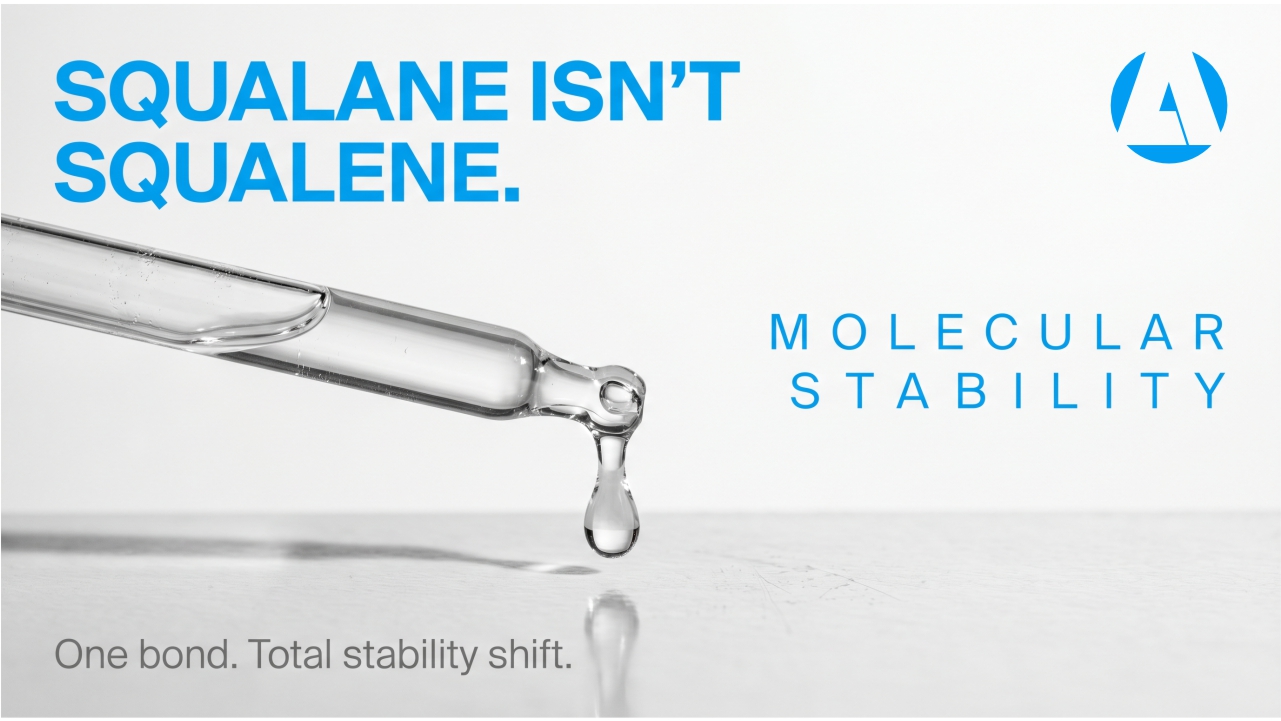
Squalane vs Squalene: Why One Letter Changes Everything About Skincare Stability
Walk down any skincare aisle and you'll spot both names on ingredient labels: squalane and squalene. They look almost identical, they come from the same chemical family, and they're often used interchangeably in marketing copy. But from a formulation standpoint, they behave in very different ways. Understanding that difference matters, whether you're a consumer trying to make sense of a label or a brand owner deciding what to put into your next product.
Why the Topic Matters
Ingredient naming confusion is common in skincare, but few examples are as consequential as this one. The distinction between squalane and squalene isn't cosmetic wordplay. It affects how a product performs over time, how it should be packaged, and how comfortable it is on different skin types. For brand owners, choosing the wrong form can mean a product that degrades on the shelf before it ever reaches a customer.
What Is Squalene?
Squalene is a naturally occurring lipid. Your skin actually produces small amounts of it as part of sebum, which is why it's often described as biomimetic. It's also found in various plant oils, including olive oil, and was historically sourced from shark liver oil, a practice most reputable manufacturers have since moved away from due to sustainability concerns.
Chemically, squalene is unsaturated. That means its molecular structure contains double bonds, which sounds like a technical detail but has a real practical consequence: those double bonds are reactive. When squalene is exposed to air, light, or heat, it oxidizes relatively quickly. Oxidized squalene can lose its beneficial properties and, in some cases, contribute to skin irritation or clogged pores.
What Is Squalane?
Squalane is the hydrogenated version of squalene. Hydrogenation is a chemical process that adds hydrogen atoms to those reactive double bonds, converting them into single bonds. The result is a fully saturated molecule that is chemically stable.
This one structural change is the reason squalane became the preferred ingredient for cosmetic formulation. It resists oxidation, has a long shelf life, and maintains a consistent texture and performance over time, something squalene struggles to do outside of tightly controlled, low-oxygen packaging.
Scientific Explanation: What Stability Actually Means in Formulation
Oxidative stability is one of the most important, and least visible, factors in skincare formulation. An oxidizing ingredient can change color, develop an off odor, and produce breakdown byproducts that may not be as skin-friendly as the original compound. This is a concern not just for the ingredient itself, but for how it interacts with the rest of a formula.
Because squalane doesn't have reactive double bonds, it integrates cleanly into a wide range of formulations without contributing to premature degradation. This makes it easier to pair with antioxidants, actives, and other emollients without worrying about accelerated oxidation cycles. Squalene, by contrast, often requires additional antioxidant support, opaque or airless packaging, and shorter recommended usage windows to maintain product integrity.
Sourcing: Where Squalane Comes From Today
Modern squalane is rarely animal-derived. Most reputable sources now come from:
- Olive oil-derived squalane, produced from olive oil byproducts during olive oil refining
- Sugarcane-derived squalane, created through fermentation of sugarcane-derived compounds
- Other plant sources such as rice bran or amaranth seed, though less common commercially
Fermentation-derived squalane, in particular, has gained traction because it doesn't rely on olive harvests and can offer more consistent batch-to-batch purity, an important consideration for brands scaling production.
Benefits of Squalane in Formulation
Squalane offers several practical advantages for both formulators and end users:
- Lightweight, non-greasy texture that absorbs without heavy residue
- Compatibility with most skin types, including oily and acne-prone skin, due to its non-comedogenic profile
- Emollient properties that help support the skin barrier and reduce transepidermal water loss
- Long-term formulation stability, reducing the risk of batch inconsistency or premature spoilage
- Versatility across product categories, from serums and moisturizers to hair and body oils
Common Myths About Squalane and Squalene
Myth: Squalane and squalene are the same thing, just spelled differently. They are chemically related but structurally distinct. The difference in stability alone makes them behave differently in a formula.
Myth: Squalane is always plant-derived and squalene is always animal-derived. Both can come from plant or animal sources today, though most commercial squalane is now plant- or fermentation-derived for sustainability reasons.
Myth: More squalane in a formula always means better hydration. Concentration matters less than how well the ingredient is incorporated into the overall formulation. A well-balanced product with supporting humectants and occlusives will often outperform a high-percentage squalane product with a poorly designed base.
Practical Tips for Brand Owners
If you're developing a product with squalane or squalene, a few formulation considerations are worth discussing with your manufacturing partner:
- Confirm the sourcing method and purity documentation, since this affects both marketing claims and regulatory filings
- Evaluate packaging needs; while squalane is more forgiving, exposure to prolonged heat or light can still affect long-term stability
- Consider how the ingredient will be layered with actives like retinol or vitamin C, since squalane's stability makes it a reliable carrier oil in multi-active formulas
- Request stability testing data before finalizing a formulation, particularly for products intended for warm or humid export markets
Frequently Asked Questions
Is squalane better than squalene for skincare? Squalane is generally preferred in formulation because of its stability, though squalene's biomimetic properties still make it valuable in certain product types when properly stabilized.
Can squalane clog pores? Squalane is widely considered non-comedogenic and is often used in formulations for oily and acne-prone skin, though individual results may vary depending on the overall formula.
Is squalane suitable for sensitive skin? Squalane is generally well tolerated across skin types due to its simple, stable molecular structure, though patch testing is always recommended for sensitive or reactive skin.
How is squalane different from mineral oil? Squalane is a naturally derived, biomimetic lipid, while mineral oil is a petroleum-derived occlusive. They serve different roles in formulation and are not directly interchangeable.
Conclusion
The difference between squalane and squalene comes down to a single chemical transformation, but that transformation has real consequences for shelf stability, texture, and formulation flexibility. For brands developing skincare products, understanding this distinction can help guide better sourcing decisions and more resilient formulations.
Looking for a manufacturing partner who understands the formulation science behind every ingredient choice? Acticon Life Sciences offers end-to-end product development and manufacturing solutions focused on quality, compliance, and innovation.