
Peptides 101: How These Tiny Proteins Signal Your Skin to Repair Itself
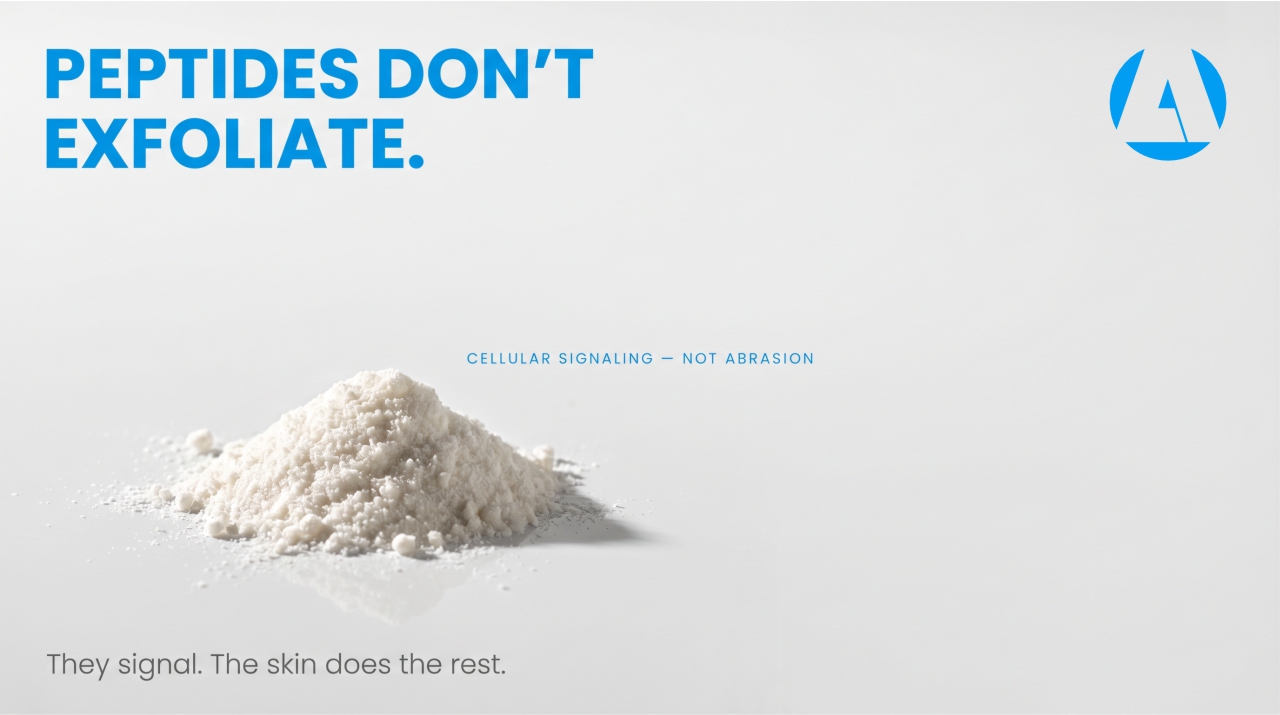
If you've browsed a skincare aisle recently, you've probably noticed "peptides" listed on more labels than ever. They sit quietly behind buzzier ingredients like retinol or vitamin C, yet they're doing some of the most foundational work in a formulation. Peptides don't exfoliate or bleach pigment. Instead, they talk to your skin cells, and that conversation is what makes them worth understanding.
Why Peptides Matter in Modern Skincare
Skin aging and damage aren't just about visible wrinkles or dullness. At a cellular level, they involve a slowdown in collagen synthesis, weakened communication between skin cells, and a less efficient repair process. Peptides matter because they intervene at this signaling stage, rather than just treating the surface. For brand owners and formulators, this also means peptides can be positioned as a science-backed, low-irritation alternative or complement to stronger actives.
What Exactly Are Peptides?
Peptides are short chains of amino acids, the same building blocks that make up proteins like collagen and elastin. Where collagen itself is a large, complex protein, peptides are essentially fragments of it, or synthetic sequences modeled after it. Because of their small size, peptides can penetrate the upper layers of skin more easily than full collagen molecules, which are generally too large to be absorbed when applied topically.
How Peptides Work: The Science Explained
Peptides function as messengers. When a peptide binds to a receptor on a skin cell, it can trigger a specific biological response, depending on the peptide's structure. Broadly, peptides used in skincare fall into a few functional categories.
Signal peptides prompt fibroblasts (the cells responsible for producing collagen and elastin) to increase output, essentially telling the skin to behave as though it needs to repair or rebuild.
Carrier peptides deliver trace minerals like copper to the skin, which support enzymatic processes involved in wound healing and collagen stabilization.
Enzyme-inhibitor peptides work differently. Rather than stimulating production, they slow down the enzymes that break down existing collagen, helping preserve what's already there.
Neurotransmitter-affecting peptides, sometimes marketed as "Botox-like" peptides, aim to gently reduce the muscle contractions linked to expression lines, though their effect is far subtler than injectables.
This variety is why "peptide" on a label doesn't tell you much on its own. The specific peptide sequence determines what it actually does.
Benefits of Peptides in Skincare
Used consistently and formulated well, peptides may help support several aspects of skin health.
They can help support the skin's natural collagen production, which may improve the appearance of firmness over time. They are generally well tolerated, making them suitable for sensitive skin types that may not tolerate stronger actives like retinoids. Peptides can also support the skin barrier, helping it retain moisture and resist environmental stressors. Because they work through signaling rather than chemical exfoliation, they typically don't cause the purging or sensitivity sometimes associated with acids or retinol.
It's worth noting that results depend heavily on formulation quality, concentration, and consistent use. Peptides are not a substitute for sun protection or a complete skincare routine.
Limitations and Formulation Challenges
Peptides are fragile molecules. Their effectiveness can be significantly reduced by poor formulation choices, unstable pH, or improper packaging. A few formulation considerations matter here.
Stability: Many peptides degrade when exposed to heat, light, or extreme pH levels. Without proper stabilization, a peptide serum can lose much of its activity before it even reaches the consumer.
Absorption: Peptide size and structure affect how well they penetrate skin. Some require delivery systems, such as liposomal encapsulation, to reach deeper skin layers effectively.
Compatibility: Peptides can sometimes be incompatible with certain acids or high concentrations of vitamin C, which may break down peptide structures. Formulators often separate these actives into different steps of a routine or different products entirely.
Packaging: Airless pumps and opaque packaging help protect peptides from oxidation and light degradation, both of which can reduce efficacy over a product's shelf life.
This is where the manufacturing side becomes just as important as the ingredient itself. A peptide serum is only as effective as the formulation science and packaging behind it.
Common Myths About Peptides
A persistent myth is that more peptides automatically mean better results. In reality, efficacy depends on which peptides are used, their concentration, and how well they're stabilized in the formula, not simply how many are listed on the label.
Another myth is that peptides work instantly. Because peptides operate through cellular signaling rather than immediate exfoliation, visible changes in firmness or texture typically take consistent use over several weeks to become noticeable.
Some also assume peptides can replace retinol entirely. While peptides are gentler, research suggests they often work best as a complementary ingredient alongside, not necessarily a full replacement for, other proven actives, depending on individual skin goals and tolerance.
Practical Tips for Choosing Peptide Products
Look for products in opaque, airless packaging, which helps protect peptide stability. Check whether the formulation pairs peptides with supportive ingredients like hyaluronic acid or ceramides, which can enhance hydration and barrier function alongside the peptide's signaling effects. Be patient. Since peptides work gradually, consistent use over 8 to 12 weeks is generally needed before assessing results. If you have sensitive skin, peptides are often a good starting point before introducing stronger actives.
Frequently Asked Questions
Are peptides safe for sensitive skin?
Generally, yes. Peptides are considered low-irritation compared to acids or retinoids, though individual sensitivity can vary, and patch testing is always a good idea.
Can I use peptides with vitamin C or retinol?
It depends on the specific formulation. Some combinations can reduce peptide stability, so many routines separate these actives into morning and evening use, or choose products specifically formulated to be compatible.
How long before I see results from peptides?
Since peptides work through cellular signaling, visible changes in firmness typically take several weeks of consistent use, individual results may vary.
Do natural peptides work as well as synthetic ones?
Both natural and synthetic peptides can be effective. What matters more is the specific peptide sequence, concentration, and how well it's stabilized in the final formulation.
Conclusion
Peptides represent a shift in how skincare approaches repair, working with the skin's own biological signaling rather than simply exfoliating or masking surface concerns. Their gentle, cumulative effect makes them a valuable addition to many routines, but their performance depends heavily on formulation quality, from stability and pH to packaging and ingredient pairing.
Looking for a reliable manufacturing partner to bring a peptide-based formulation to life? Acticon Life Sciences offers in-house R&D and formulation support focused on ingredient stability, compliance, and consistent batch quality for skincare and personal care brands.