
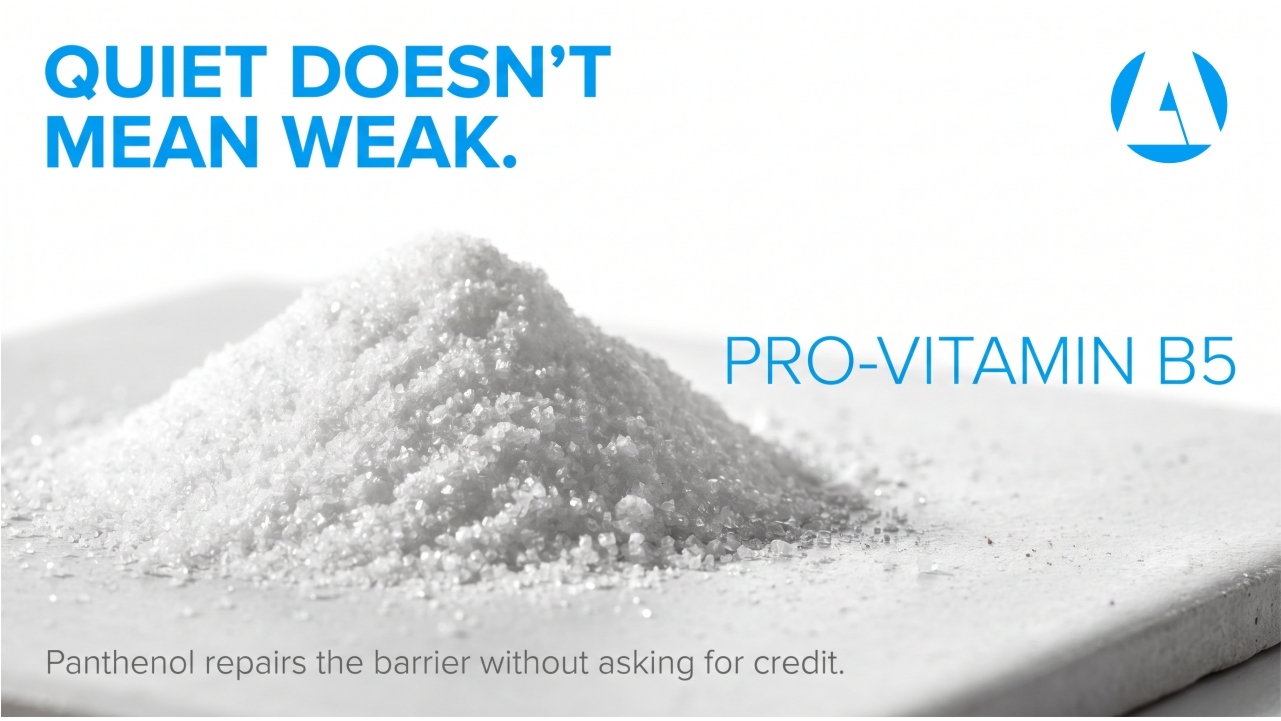
Panthenol: The Quiet Workhorse Behind Barrier Repair and Hydration
Walk down the ingredient list of almost any moisturizer, serum, or aftershave, and there's a good chance panthenol is somewhere on it. It rarely gets the spotlight the way retinol or vitamin C does, but it plays a supporting role in more formulations than most consumers realize.
Why This Ingredient Matters
Skin barrier health has become a central conversation in skincare over the past few years, and for good reason. When the barrier is compromised, whether from over-exfoliation, harsh cleansers, or environmental stress, skin becomes more prone to irritation, dryness, and sensitivity. Panthenol is one of the more established ingredients formulators reach for to help address this, both for its hydrating properties and its long safety record.
What Panthenol Actually Is
Panthenol is the alcohol form of pantothenic acid, which is vitamin B5. That's why it's often labeled pro-vitamin B5. Once applied to skin, panthenol converts into pantothenic acid, which the body uses in various metabolic processes, including those involved in skin repair.
It's a colorless, slightly viscous liquid (or a white crystalline powder, depending on the form) that dissolves easily in water. This makes it convenient to work with across a wide range of product types, from lightweight toners to richer creams.
How Panthenol Works on Skin
Panthenol works through a few overlapping mechanisms rather than a single dramatic action, which is part of why it fits into so many formulations.
First, it functions as a humectant, meaning it draws moisture from the air and deeper skin layers into the surface. This helps improve short-term hydration and gives skin a smoother, plumper appearance.
Second, research suggests panthenol supports the skin's natural barrier function by helping maintain the lipid matrix that holds skin cells together. A stronger barrier means less water loss through the skin and better resilience against external irritants.
Third, panthenol has a documented history in wound care and dermatology, where it's been used to support skin healing after minor injuries or irritation. This background is part of why it shows up so often in after-sun products, post-procedure skincare, and formulas for sensitive or compromised skin.
Benefits Worth Understanding
Panthenol's benefits are modest but well-supported, which is exactly why it has stayed relevant in formulation for decades rather than fading as a trend.
It can improve skin hydration and softness with regular use. It may help calm visible redness or irritation, which is why it frequently appears alongside soothing ingredients like allantoin or centella asiatica. It supports barrier function, which indirectly helps skin tolerate actives like retinoids or acids better when included in the same routine. And it has a strong safety and tolerability profile, making it suitable for use across most skin types, including sensitive skin, when the overall formulation is well-balanced.
It's worth noting that panthenol isn't a treatment ingredient in the way retinol or niacinamide can be. It doesn't target specific concerns like pigmentation or fine lines. Its role is more foundational, supporting comfort, hydration, and barrier resilience.
Common Myths About Panthenol
One persistent myth is that panthenol is simply "vitamin B5 for hair," left over from its popularity in hair care products like Pantene (a name derived from panthenol). While it does benefit hair, its skin applications are equally well-documented and distinct.
Another misconception is that more panthenol automatically means better results. Formulation concentration matters, but so does the overall product base. A well-formulated product at a modest panthenol percentage often outperforms a poorly balanced one with a higher percentage, since stability, pH, and supporting ingredients all influence how well any active performs.
Some also assume panthenol is purely a marketing ingredient with little functional benefit. In reality, its use in wound care and dermatological settings predates its popularity in cosmetics, and its moisturizing and barrier-supporting effects are supported by decades of use and research.
Formulation Considerations
For skincare brands and formulators, panthenol is generally considered easy to work with, but a few practical points matter.
Stability: Panthenol is relatively stable across a broad pH range, though extreme pH or prolonged heat exposure during manufacturing can affect its performance. Careful process control during batch production helps preserve efficacy.
Solubility: It's water-soluble, which makes it straightforward to incorporate into aqueous phases during formulation, whether in a serum, toner, or the water phase of an emulsion.
Compatibility: Panthenol pairs well with most other common skincare actives, including hyaluronic acid, niacinamide, and ceramides. It's frequently used as a supporting ingredient rather than the hero of a formula, which is part of what makes it so versatile.
Packaging: Because it's water-soluble and not particularly sensitive to light or air compared to ingredients like vitamin C, panthenol doesn't usually require specialized packaging, though general best practices for preservation and stability still apply.
Practical Tips for Choosing Panthenol Products
For consumers, panthenol is generally well tolerated and can be a useful ingredient to look for in moisturizers, especially for those dealing with dryness, mild irritation, or a compromised barrier from environmental stress or overuse of actives.
For brand owners developing a formulation, panthenol works well in products aimed at sensitive skin, post-sun care, barrier-repair moisturizers, and everyday hydrating serums. It's often combined with other soothing or barrier-supporting ingredients to create a more complete formula, and depending on the product's positioning, the concentration and supporting ingredient matrix should be adjusted with formulation testing and stability studies.
A Note on Formulation Quality
As with most skincare ingredients, panthenol's effectiveness depends heavily on the overall formulation rather than its presence alone. Factors like the surrounding ingredient matrix, pH balance, emulsion stability, and manufacturing process all influence how well a product performs once it reaches the consumer. This is one of the reasons formulation science and quality manufacturing matter just as much as ingredient selection.
Frequently Asked Questions
Is panthenol the same as vitamin B5? Panthenol is a derivative of vitamin B5 (pantothenic acid). It converts into pantothenic acid once absorbed by the skin, which is why it's often referred to as pro-vitamin B5.
Can panthenol be used with retinol or exfoliating acids? Yes, panthenol is generally compatible with retinoids and exfoliating acids. It's often included in formulations specifically to help support the skin barrier while using stronger active ingredients.
Is panthenol suitable for sensitive or acne-prone skin? Panthenol is typically well tolerated by sensitive skin due to its soothing and barrier-supporting properties. For acne-prone skin, formulation matters more than the ingredient itself, so the overall product should be assessed for comedogenicity.
How is panthenol different from hyaluronic acid? Both are hydrating, but they work differently. Hyaluronic acid primarily draws and holds water at the skin's surface, while panthenol supports hydration and also contributes to barrier function and skin comfort.
Does panthenol have any known side effects? Panthenol has a strong safety profile and is rarely associated with irritation. As with any ingredient, individual sensitivities are possible, so patch testing is recommended when trying a new product.
Conclusion
Panthenol may not carry the same buzz as trending actives, but its consistent performance and strong safety profile explain why it remains a staple in skincare formulation. Whether the goal is barrier support, hydration, or improved tolerability alongside stronger actives, panthenol continues to earn its place in well-formulated products.
For brands developing formulations that rely on ingredients like panthenol, getting the supporting matrix, stability, and manufacturing process right is just as important as the ingredient choice itself. Acticon Life Sciences offers end-to-end formulation development and manufacturing support for skincare, cosmetics, pharmaceuticals, and nutraceuticals, helping brands bring well-formulated, stable products to market.