
Pack Size vs. Price Point: The Pricing Psychology Every Skincare Brand Should Know
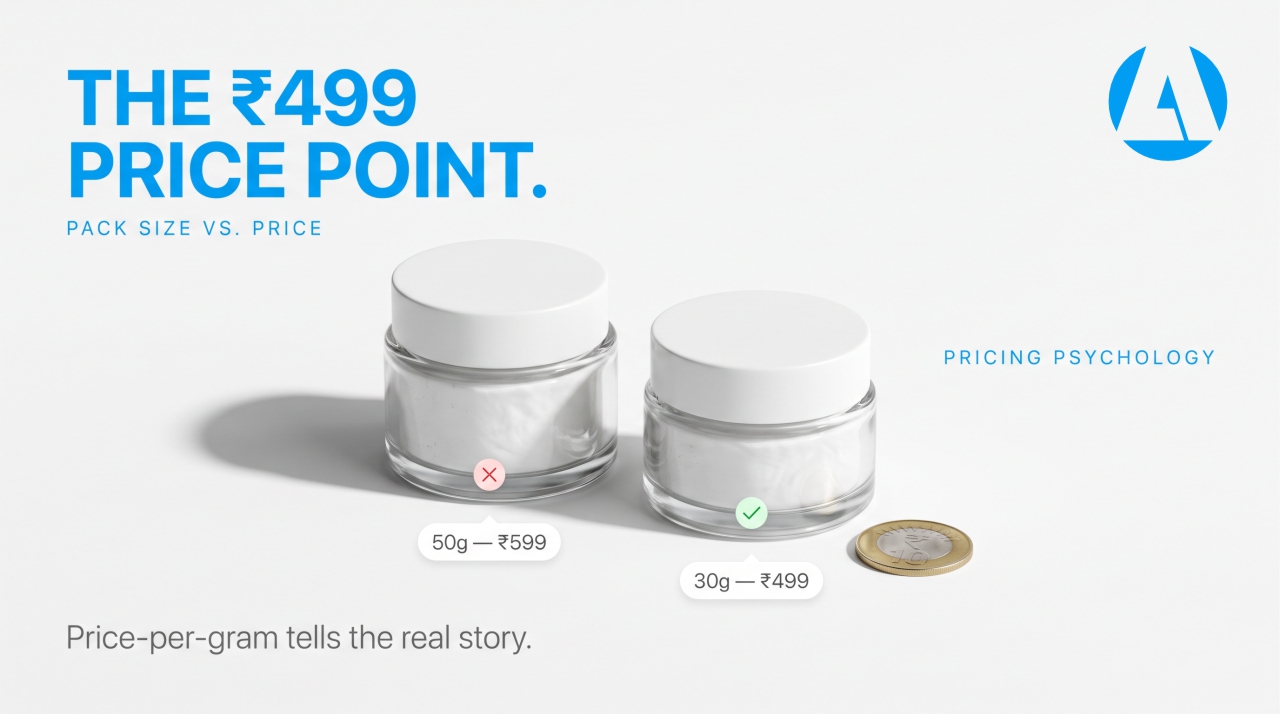
A two-rupee difference sounds trivial. On paper, it is. At the shelf, it can decide which product a customer picks up and which one stays behind.
This isn't unique to any one category. It shows up in food, beverages, and just as often in skincare and personal care. A face wash priced at ₹115 can lose out to a smaller size priced at ₹99, even when the ₹115 pack offers more product per rupee. Price-sensitive buyers rarely calculate cost per milliliter at the counter. They react to the number on the label.
For skincare brand owners, understanding this behavior isn't about manipulating customers. It's about designing products and pricing that meet people where they already are.
Why the Topic Matters
Skincare and personal care brands compete on more than formulation. Distribution, shelf visibility, and price perception often decide whether a good product ever gets a fair trial.
Brand owners who ignore pricing psychology tend to make one of two mistakes. They either underprice a product to compete on a number, which erodes margin, or they overprice it for the value delivered, which limits reach in price-sensitive markets. Neither approach is sustainable at scale.
Pack size strategy offers a third option. Instead of changing the price, brands can change the amount of product in the pack to land on a number that feels easy and familiar to the buyer, while protecting revenue per unit sold.
Main Content: The Psychology Behind Price Points
Certain price points feel easier to spend than others. A ₹99 or ₹199 price tag often reads as more approachable than ₹105 or ₹210, even though the difference is small. This is sometimes called a "magic price point," and it tends to align with round numbers, single-note or single-coin transactions, or figures just under a round threshold.
Consider two hypothetical products:
- Product A: 100 ml serum priced at ₹120 (₹1,200 per liter)
- Product B: 80 ml serum priced at ₹99 (₹1,237 per liter)
Product A technically offers more value per milliliter. But Product B may outsell it, because the buyer is reacting to the sticker price, not the underlying unit economics. For brands selling through general trade, pharmacies, or price-conscious e-commerce segments, this gap can meaningfully affect conversion.
Scientific and Strategic Explanation
This isn't a skincare-specific phenomenon. It's a well-documented pattern in consumer behavior known as price point anchoring, where round or "easy" numbers reduce the mental effort of a purchase decision. In categories with frequent, low-involvement purchases, like a daily face wash or a body lotion, this effect tends to be stronger than in categories where buyers already research extensively before purchasing, such as anti-aging serums or dermatologist-recommended treatments.
Formulation cost, packaging cost, and fill volume all factor into where a brand can realistically set a price. Adjusting pack size, rather than compromising formulation quality, is often the more sustainable lever.
Benefits of a Deliberate Pack Size Strategy
- Protects the price point. A brand can launch a smaller fill size at a familiar, easy-to-transact price instead of asking customers to accept a higher number.
- Can improve revenue per liter or kilogram. A smaller pack at a slightly adjusted price sometimes yields better realization than a larger pack at a proportionally lower price.
- Supports trial and repeat purchase. Smaller, accessible pack sizes lower the barrier for first-time buyers to try a new skincare product.
- Reduces switching to competitors. When a brand's price feels out of reach by even a small margin, buyers may switch to a competing product without much hesitation.
Common Myths
Myth: A bigger pack always wins on shelf. Larger packs suit brand owners who already have loyal repeat customers. For new customer acquisition, smaller trial sizes at accessible price points often perform better.
Myth: Lowering price is the only way to compete. Lowering price without adjusting fill volume can pressure margins across the entire supply chain, including manufacturing partners. Adjusting pack size, formulation cost structure, or packaging format is usually more sustainable.
Myth: Pricing strategy is separate from formulation and manufacturing decisions. Pack size, fill volume, and packaging format are manufacturing decisions as much as they are marketing decisions. They need to be planned together from the earliest stages of product development.
Practical Tips for Skincare Brand Owners
- Map your target price points before finalizing fill volume, not after.
- Work with your manufacturing partner early to understand how fill size affects packaging cost, MOQs, and per-unit economics.
- Test multiple pack sizes in a single SKU family, such as a travel size and a standard size, to serve different customer segments.
- Review price-per-unit competitiveness regularly, especially in categories with frequent repurchase, like cleansers and moisturizers.
- Avoid compromising formulation quality or active ingredient concentration just to hit a price point; adjust volume instead.
Frequently Asked Questions
Q: Does a smaller pack size mean lower quality? No. Pack size refers to the amount of product in the container. Formulation quality, active ingredient concentration, and stability depend on the formula itself, not the fill volume.
Q: How do I decide the right pack size for my skincare brand? This depends on your target price point, customer segment, and distribution channel. A contract manufacturer with formulation and packaging expertise can help model different fill sizes against your target retail price.
Q: Can pack size strategy work for pharmaceutical or nutraceutical products too? Yes. Similar principles apply to over-the-counter personal care and nutraceutical products, though pricing and packaging decisions must always remain within applicable regulatory guidelines for the product category.
Q: Will changing pack size affect my minimum order quantity (MOQ)? It can. Smaller fill sizes may require different packaging components, which can affect MOQs. It's worth discussing this early with your manufacturing partner.
Conclusion
Pricing in skincare and personal care isn't purely about the cost of ingredients or manufacturing. It's also about how a number is perceived at the moment of purchase. Brand owners who plan pack size and price point together, rather than treating them as separate decisions, tend to protect both their margins and their shelf position.
Planning pack sizes and pricing strategy for a new skincare, cosmetic, or personal care line? Acticon Life Sciences supports brand owners with formulation development, packaging options, and fill-size planning as part of end-to-end private label and contract manufacturing solutions.