
Fragrance-Free vs Unscented: Why That One Word Matters for Sensitive Skin
Walk down any skincare aisle and you'll see both words everywhere: fragrance-free and unscented. Most people assume they mean the same thing. They don't. And if you have sensitive, reactive, or eczema-prone skin, that difference can be the reason a product works beautifully for one person and causes redness or itching for another.
Understanding these two terms isn't about chasing a trend. It's about reading labels the way formulators actually intend them to be read, so you can make informed choices about what goes on your skin.
Why the Topic Matters
Fragrance is one of the most common triggers of contact dermatitis and skin sensitization worldwide. It's added purely for sensory appeal, not for any skin benefit, which means it's often the first thing dermatologists recommend removing when someone is dealing with unexplained irritation.
The problem is that "unscented" has become a marketing shortcut, and many consumers assume it's synonymous with "no fragrance at all." That assumption can lead people with genuine fragrance sensitivities to unknowingly reintroduce the very ingredient they're trying to avoid.
What "Fragrance-Free" Actually Means
A truly fragrance-free product contains no added fragrance ingredients of any kind. This includes:
- Perfume or parfum compounds
- Essential oils used for scent
- Masking fragrances added solely to neutralize the smell of other raw materials
Some raw materials, like certain plant extracts or surfactants, have a natural odor. A fragrance-free formulation either sources odor-neutral versions of these ingredients or accepts a mild, unmasked scent rather than covering it up with fragrance.
What "Unscented" Actually Means
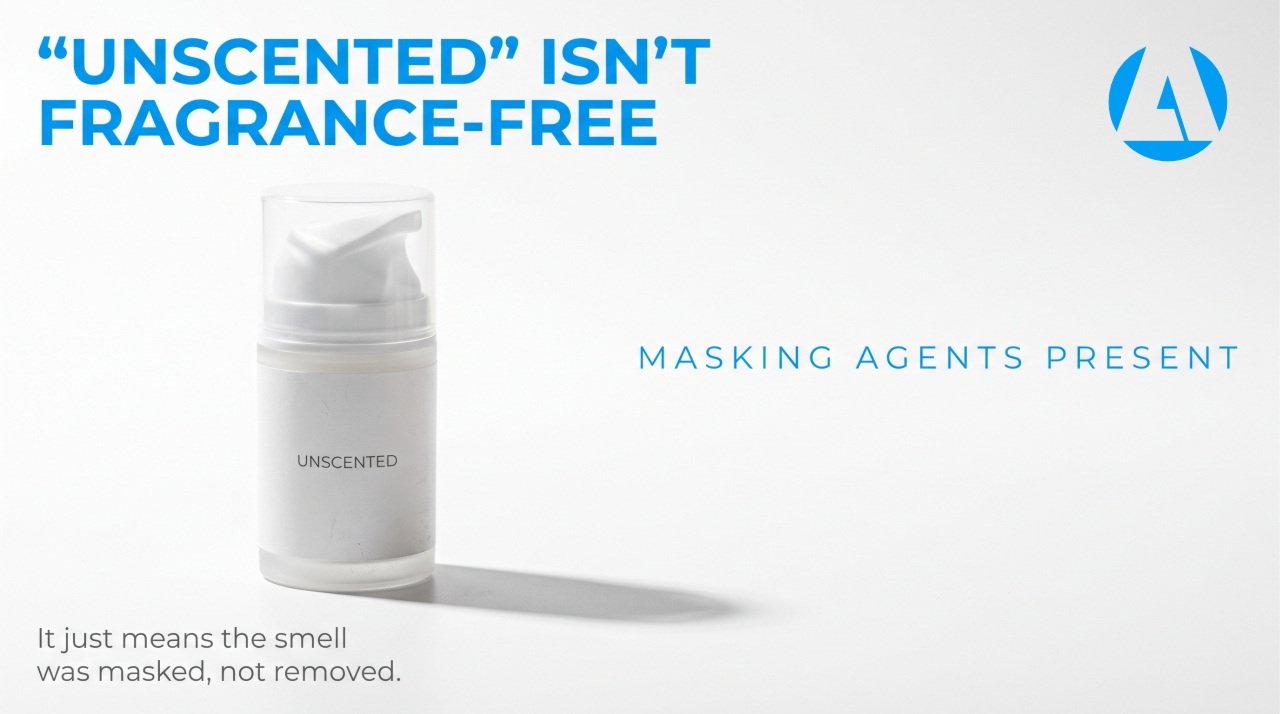
Unscented products are formulated to have no perceivable smell to the end user, but this doesn't always mean fragrance was left out entirely. In many cases, brands add a small amount of masking fragrance specifically to cancel out the natural odor of other ingredients. The result smells like nothing, but a fragrance compound was technically part of the process.
For most people, this distinction is irrelevant. For someone with a documented fragrance allergy or highly reactive skin, it can matter quite a bit, since even trace masking fragrances can trigger a reaction.
The Scientific Reasoning Behind It
Fragrance allergens are typically small, volatile molecules that penetrate the skin barrier easily and can trigger an immune response in sensitized individuals. Regulatory bodies in the US and EU require specific fragrance allergens to be listed individually on ingredient labels once they exceed a certain concentration, which is why you'll sometimes see names like linalool or limonene listed separately from "fragrance" or "parfum."
This is also why dermatologists often recommend patch testing new products, particularly for anyone with a history of contact dermatitis, before applying them to the full face.
Common Myths
Myth: Unscented means the same as fragrance-free. As covered above, unscented products can still contain masking fragrance. Always check the ingredient list, not just the front-of-pack label.
Myth: Natural fragrance is safer than synthetic fragrance. Essential oils and other natural aromatic compounds can be just as likely, sometimes more likely, to trigger sensitization as synthetic fragrance compounds. The source doesn't determine the risk; the specific molecule and concentration do.
Myth: If a product doesn't smell like anything, it's fragrance-free. A well-formulated masking fragrance can be completely undetectable by scent alone while still being present in the formula.
Practical Tips for Sensitive Skin
- Look for "fragrance-free" specifically on the label, not just "unscented"
- Scan the full ingredient list for parfum, fragrance, linalool, limonene, geraniol, or citral
- Patch test new products on the inner forearm for 48 hours before facial use
- Introduce one new product at a time so you can identify a trigger if a reaction occurs
- Ask your contract manufacturer or brand for full ingredient disclosure if labeling feels unclear
Practical Implications for Brand Owners
For brands developing sensitive-skin lines, this distinction is a formulation decision, not just a labeling one. Choosing genuinely fragrance-free raw materials, including preservatives and surfactants that don't carry a masking scent, requires careful sourcing and can affect texture, stability, and shelf life. Working with a manufacturing partner that understands allergen documentation and ingredient traceability makes it easier to substantiate fragrance-free claims accurately and avoid regulatory or consumer trust issues down the line.
Frequently Asked Questions
Is fragrance-free skincare better for everyone? Not necessarily. Fragrance-free is most beneficial for people with sensitive, reactive, or compromised skin barriers. For skin without sensitivity concerns, fragrance in moderate, well-formulated amounts typically isn't a problem.
Can "unscented" products still cause allergic reactions? Yes, depending on the formulation. If a masking fragrance was used, individuals with fragrance allergies may still react even though the product has no detectable smell.
How can I tell if a product is truly fragrance-free? Check the ingredient list for terms like fragrance, parfum, or specific allergen names. A genuinely fragrance-free product will not list any of these.
Are essential oils considered fragrance? Yes. When used for scent, essential oils are classified as fragrance ingredients and can trigger the same sensitivities as synthetic fragrance compounds.
Does fragrance-free mean a product won't smell like anything? Not always. Some raw materials have a mild natural odor, so a fragrance-free product may have a faint scent from the ingredients themselves rather than an added fragrance.
Conclusion
The words "fragrance-free" and "unscented" look similar but represent very different formulation approaches. For most consumers, the difference is minor. For those with sensitive skin or documented fragrance allergies, it can be the deciding factor between a product that soothes and one that irritates. Reading the full ingredient list, rather than relying on front-of-pack claims, remains the most reliable way to make an informed choice.
Looking for a reliable manufacturing partner for skincare, cosmetics, pharmaceuticals, or nutraceuticals? Acticon Life Sciences offers end-to-end product development and manufacturing solutions focused on quality, compliance, and ingredient transparency.